We verified 25 hotels near two major Tokyo rail stations against their own official pages, each with a room where two adults and two children aged 8 and 10 can stay together, and asked three AI assistants, ChatGPT, Gemini, and Perplexity, to recommend hotels, in general and for that family. Some of the hotels state the room's capacity for four on the page that lists their rooms; the rest keep it on a deeper page. The results first. All four pairs in the second station area favoured the clear-overview hotel, while two of three pairs in the first station area favoured the deeper-information hotel. Our predeclared rule required the pattern in both areas before we would call it repeated, so that rule was not met. In the second area, the median paired difference in lift was +51.7 percentage points; in the first area it was −27.1 percentage points.
All businesses are anonymised; no names, links, or quotations from the answers are reproduced.
What we tested
We verified 25 hotels near two major Tokyo rail stations against their own official pages for room fit: each one offers a room where two adults and two children aged 8 and 10 can stay together. We then split the hotels by one feature of their official English website:
- Clear-overview hotels: the page that lists the hotel's rooms states the room's capacity for four on that page.
- Deeper-information hotels: an English overview exists but omits that capacity; the information is verifiable only on a detail, policy, FAQ, or Japanese page.
Hotels were matched into 7 pairs (one of each kind per pair, matched on type and brand profile) across the two station areas: 3 pairs in the first area and 4 in the second. Only three pairs could be formed in the first area, so that area's results are labelled exploratory. The other 11 verified hotels were measured on the same questions but could not be paired, so they sit outside the paired comparison below. Of the 25 verified hotels, 23 were recommended at least once.
We scheduled 240 queries to three web-enabled AI assistants, ChatGPT, Gemini, and Perplexity (2 areas × 2 question types × 2 wordings × 3 systems × 5 repetitions × 2 days): general questions ("recommend up to three hotels near the station") and family questions (the same, for two adults and children aged 8 and 10 in one room). We collected 239 valid answers; one query, in the first area's family questions, returned no answer, so that one set rests on 59 answers instead of 60. A hotel counted when it was explicitly recommended among the first three options in an answer. Each answer could name up to three hotels, so the 239 answers contain 699 recommendation slots in total; 6 of those slots could not be resolved to a specific hotel.
Two terms used below: a hotel's lift is its family recommendation rate minus its general recommendation rate, and a pair's difference is the clear-overview hotel's lift minus its pair mate's lift. Before scoring, we declared the rule for this study: the pattern would be called repeated only if it appeared in both station areas. As a further check, we also looked at the 4 pairs in which both hotels publish an explicit child-age rule (one pair in the first area, three in the second). Removing the block of queries that contained the one unanswered query leaves every pair's direction unchanged, so the missing answer does not drive any result below.
For citations, ChatGPT's and Perplexity's sources were taken from each hotel's own answer section; Gemini's sources were matched to hotels from the answer-wide source list.
What we found
All four pairs in the second station area favoured the clear-overview hotel, while two of three pairs in the first station area favoured the deeper-information hotel. Our predeclared rule required the pattern in both areas before we would call it repeated, so that rule was not met.
In the second station area, clear capacity information was associated with much higher family visibility: the median paired difference in lift was +51.7 percentage points.
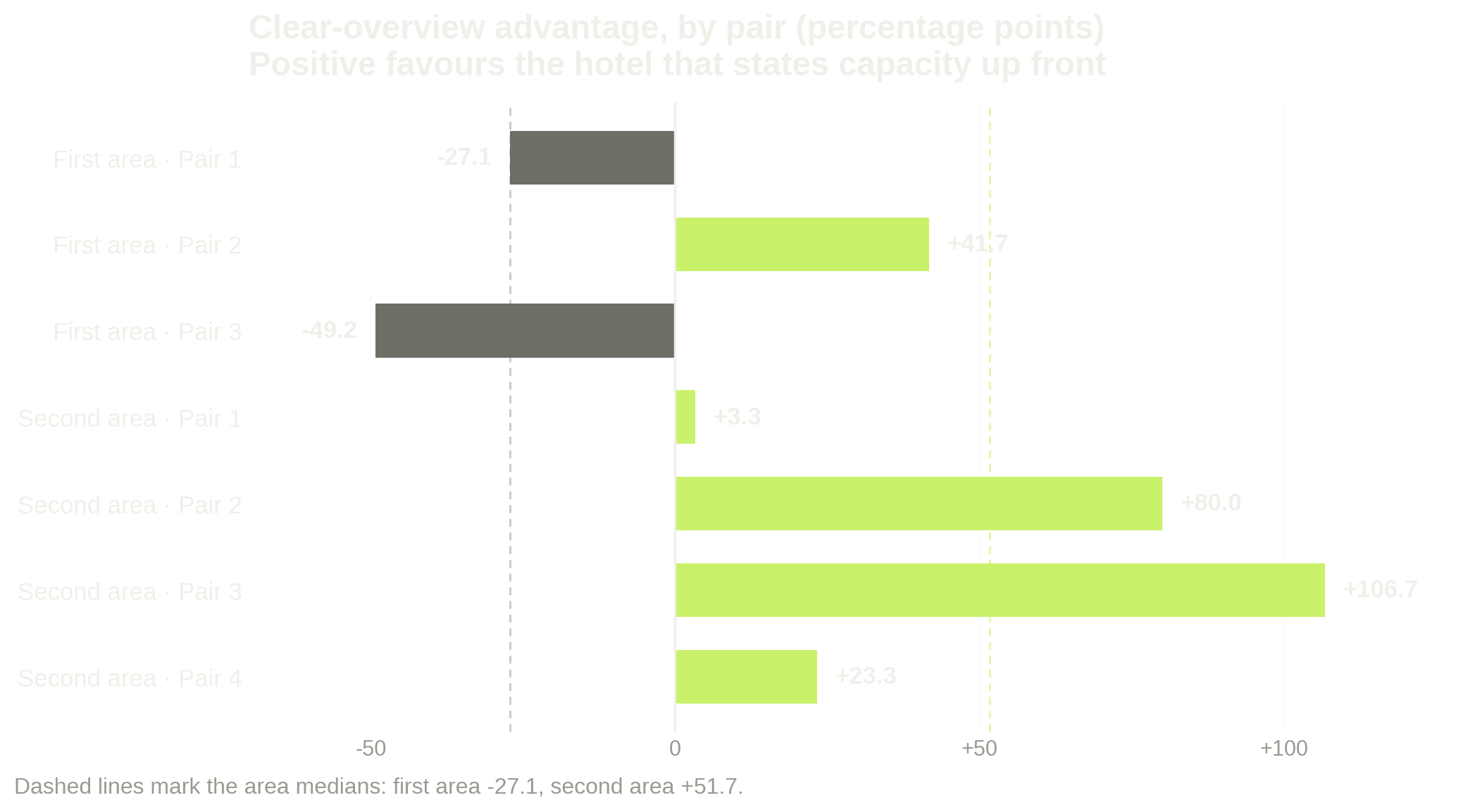
- In the pair with the largest difference, the clear-overview hotel appeared in 23 of 60 family answers (38%) and 0 of 60 general answers, while its deeper-information pair mate appeared in 57 of 60 general answers (95%) but only 16 of 60 family answers (27%). The hotel the assistants recommended to almost everyone fell sharply when the question was about a family of four.
- One clear-overview apartment hotel was recommended in 51 of 60 family answers (85%) in its area, across all three AI systems, both days, and both wordings, compared with 2 of 60 general answers (3%).
In the first station area, the pattern reversed. The median paired difference was −27.1 percentage points, and 2 of the 3 pairs favoured the deeper-information hotel. One deeper-information hotel had the largest rise in its area (0 of 60 general answers to 29 of 59 family answers, 49%), while its clear-overview pair mate was not recommended, mentioned, or cited in any of the 239 answers. Travel and guide sites appeared among the citations for this hotel; the data show which sources were cited, and leave open whether those sources drove the recommendations.
The fall on family questions was not limited to paired hotels. In the first area, the hotel recommended in every general answer (60 of 60) fell to 36 of 59 family answers, and another fell from 32 of 60 general answers to 5 of 59 family answers. Being the default answer to a general question did not protect a hotel when the question specified a family of four.
The three assistants also disagreed with each other. In one second-area pair, Gemini recommended the clear-overview hotel in 15 of 20 family answers while ChatGPT did so in 1 of 20. In another pair, Perplexity recommended a hotel in 8 of 20 family answers and ChatGPT in none. The figures above pool the three systems; for individual hotels, which assistant is asked can matter as much as what is asked.
The sensitivity check on the 4 pairs in which both hotels publish an explicit child-age rule favoured the clear-overview hotel in all 4 pairs. In one of those pairs, though, both hotels lost family visibility, and favouring there means the clear-overview hotel lost less.
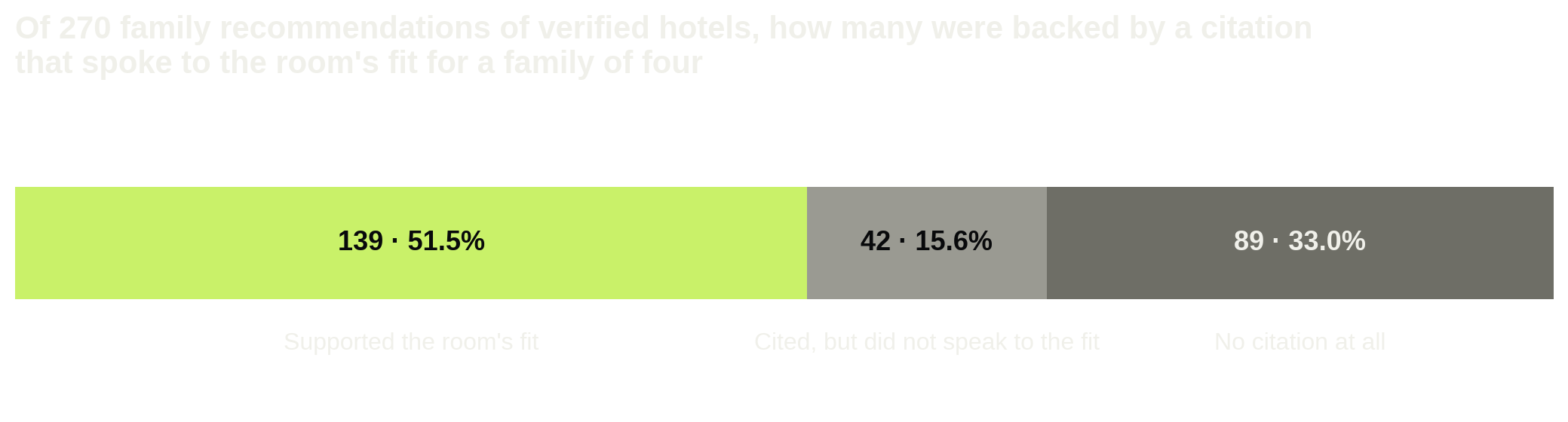
Citations were weak throughout. Of the 270 family recommendations of verified hotels, 139 (51.5%) were supported by a citation that spoke to the specific room's fit for the family; 131 (48.5%) were not, and 89 (33.0%) carried no citation at all. Support was about the same for the two kinds of hotel (50.5% of clear-overview recommendations, 53.1% of deeper-information recommendations). None of the reviewed citations was tagged as contradicting a verified hotel's room fit.
Hotels outside the verified set took 236 of the 699 recommendation slots (33.8%), so the verified hotels are not the whole answer space.
What this does and does not show
These are repeated observations of three AI systems on two days; the hotels and pairs are the units compared. Individual hotels could still move between days and wordings: one hotel received no family recommendations on the first day and 7 of 29 on the second. Clear capacity information on an official overview was associated with higher family visibility in one area and appeared more often alongside it in the sensitivity subset. This test does not show that editing a page causes a change. A follow-up test, in which one hotel moves its capacity statement to its overview and answers are re-measured, would be needed for that.